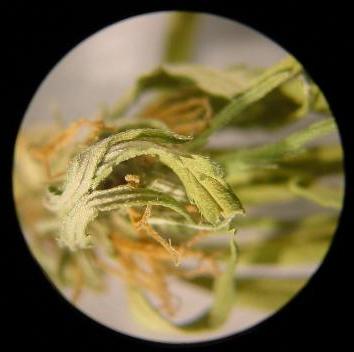
Marijuana sample under the microscope
In the Greenville Laboratory Drug Analysis section we only analyze physical quantities of drugs. That's a fancy way of saying that we look at powders and tablets instead of checking blood and urine for drugs. When someone is arrested and is suspected of being in possession of a controlled substance it comes to the lab for testing. We have to test it for two reasons. First, you can't send people to jail without proof (and sometimes you can't send them to jail even when you have proof) and second, the length of the sentence is based on the specific drug and how much there was. When I say "how much there was" I mean the total weight or count of the evidence. It doesn't matter how pure a drug is or what percentage of a sample is a drug in South Carolina. State law says that if it's part drug it's all drug. An example would be if someone mixed a little cocaine with a pound of flower, they now have a pound of cocaine in the eyes of the law.
Now that you know the why, I can tell you the how. Every step that the evidence takes is recorded electronically to insure the Chain of Custody. To get the evidence I have to go to the Property & Evidence storage room and sign for custody. I then return to the lab and begin my analysis. All the drugs are sealed when the officer turns them in, so I start by making sure it is still sealed. I then open it and initial and date the opening. So I don't have to keep repeating myself, we initial and date everything we do. It may be two years or more before this case goes to court, and my markings are the only thing that helps me recognize the evidence. I now will either weigh the sample (for plant material, powders etc.), get a count if it is in dosage units (tablets, capsules etc.) or if the sample is in liquid form we measure the volume. Up to this point every case is treated the same. Now it depends on what the evidence is as to which tests we conduct.
Marijuana analysis is broken out from the other drugs for our statistics. In the past, Marijuana only required a positive Chemical test and a positive Microscopic test. Now that the hemp law is in effect, marijuana can only be identified if the Delta-9 THC content is higher than 0.3%. To determine this we perform a semi-quantative analysis using the Gas Chromatograph Mass Spectrometer (more on this instrument below). The Marijuana microscopic test is still required and consists of checking for four characteristics: cystolithic hairs, glandular hairs, simple hairs and serrated edges. The image below is a marijuana sample as seen under the microscope.
All other drug samples are confirmed by instrumental analysis. To determine which instrument will be best to use, a presumptive analysis is conducted. That is just something we use to help us get started in the right direction. In most cases, it will a chemical color test. These tests give us an idea of what a substance is and help us rule out what a substance isn't. The color tests can't confirm the identity of a substance. If our evidence is a pharmaceutical product (tablets, capsules etc.), the presumptive test will just be to look up the markings. In the Greenville Laboratory we have two instruments that we use to confirm a controlled substance. They are the Fourier Transform Infrared Spectrophotometer (FTIR) and the Gas Chromatograph Mass Spectrometer (GCMS). A sample only needs to be identified on one of these instruments to complete the analysis.
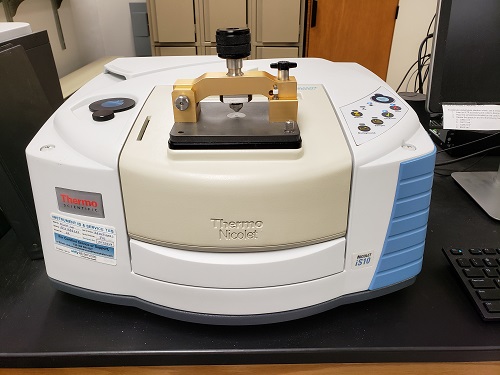
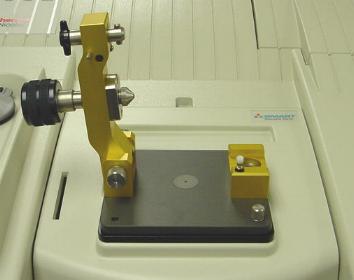
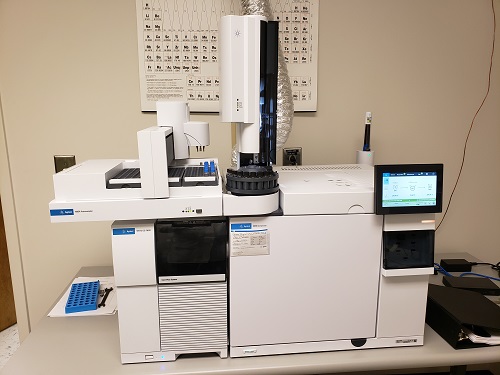
When the specific analysis for a sample is completed we go back to treating every case the same again. I reseal the evidence, type a report of my findings and return the evidence to the Property & Evidence storage area. If necessary, I will later testify to my findings as an expert witness in court.